
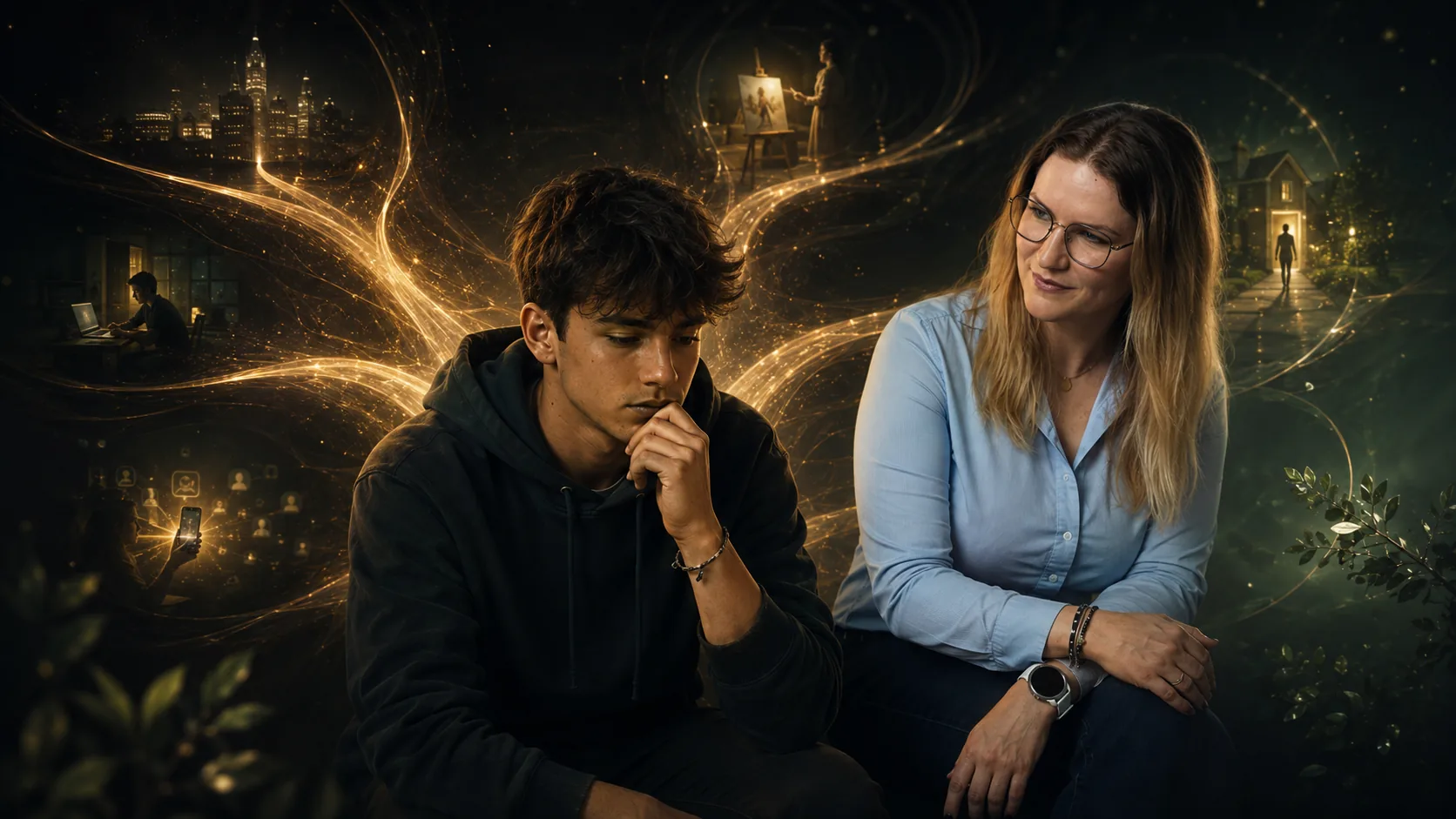
The scenario below is fictional — it shows one of several possible ways coaching work spread across a few sessions can unfold, and it isn't a record of actual conversations. The sessions I have with clients remain confidential.
David, 18. Fresh out of high school. For the first time, he's facing several big decisions at once, and he feels like each one could shape the years ahead. He comes to the first session because, as he puts it, someone should help him sort this out.
Session 1 — a flood of questionsI didn't start by sorting this list out for David. Instead, I asked what in all of this really belonged to him, and what had come from outside. That question alone was new for him — until then, he'd treated these topics as one inseparable whole.
Session 2 — college or workIn the second session, we came back to the question of college. Instead of asking whether it was worth it, I split the topic into three questions: what David wants, what he wants to find out, and what he's just assuming.
From there, we started building the criteria that actually mattered to him: what he wants to learn, how he wants to live over the next two or three years, whether he wants to combine studying with work, and how important financial independence is to him. It's a process very similar to the one described in the article on career coaching — except for David, it's a first choice, not a change.
Session 3 — friends on TikTokThe third session started with a topic I didn't want to judge in advance — not making light of it, and not suggesting it was the one right path either.
For David, the topic of TikTok started leading to a different question: how much he's actually drawn to creating, and how much he's comparing his own starting point to a result he sees in his friends. I asked whether he knew the beginning of their story, or only what he sees now. He admitted he had no idea how many attempts and failures came before it — he only sees the outcome.
Session 4 — independenceThe question "I have to move out" turned into a question about what being independent actually means to David — a much broader question than a mailing address. This thread, together with the parental expectations that already came up in the first session, is close to what I describe in the article on difficult family relationships.
Session 5 — the relationshipWe spent the fifth session on the relationship — briefly, because the topic didn't need more than that.
Where David Is After a Few Sessions
After a few sessions, David's life isn't all planned out. He still doesn't know whether he'll ultimately choose college, or which program would be right. But he has a few things he wants to check out: an open day, a conversation with current students, and whether studying can be combined with work. He hasn't ruled out TikTok either — he wants to find out in practice whether he's drawn to creating itself, or mainly to the idea of a quick result. He isn't moving out of his parents' place just because he turned eighteen, but he's starting to take on more responsibility for his own expenses. He talks with his girlfriend about their plans, instead of building his decision around her choice.
I didn't give him an answer to the question "what should I do?" Together, we built a way for him to make future decisions on his own.
"I'm 18. What should I do now?"
↓
I don't need to know what I'll be doing for the rest of my life. I need to know what next step I want to try.
What This Process Didn't Give David
I didn't give David a checklist of decisions or a ready-made plan for the next few years. I didn't tell him whether to go to college, get a job, or whether TikTok was a good idea. I asked questions that helped him name what was genuinely his question, and what was really someone else's expectation he'd taken on — and then start checking answers instead of guessing them in advance.
If you recognize a similar moment in yourself (or in someone close to you) — a lot of questions at once and the pressure to already have it all figured out — see what life coaching can look like at this stage of life.